Do They Speak English In Timisoara?
English in Timisoara, western Romania: where it works, where it does not, what the city's multilingual history means for visitors, and the phrases worth knowing.
Timisoara, in Timis County in the Banat region of western Romania, has spent three centuries absorbing languages, and English now sits comfortably on top of that stack. The city that prints its history in Romanian, Hungarian, and German, and that has hosted state theatres in all three since 1953, has added English as the language it uses with the roughly 70 percent of Tourist Information Centre visitors who arrive from abroad. This page works from what the sources say: the city hall's own reporting, the tourist office's visitor data, and the listings of the local tour operators.
How Widely Is English Spoken In Timisoara?
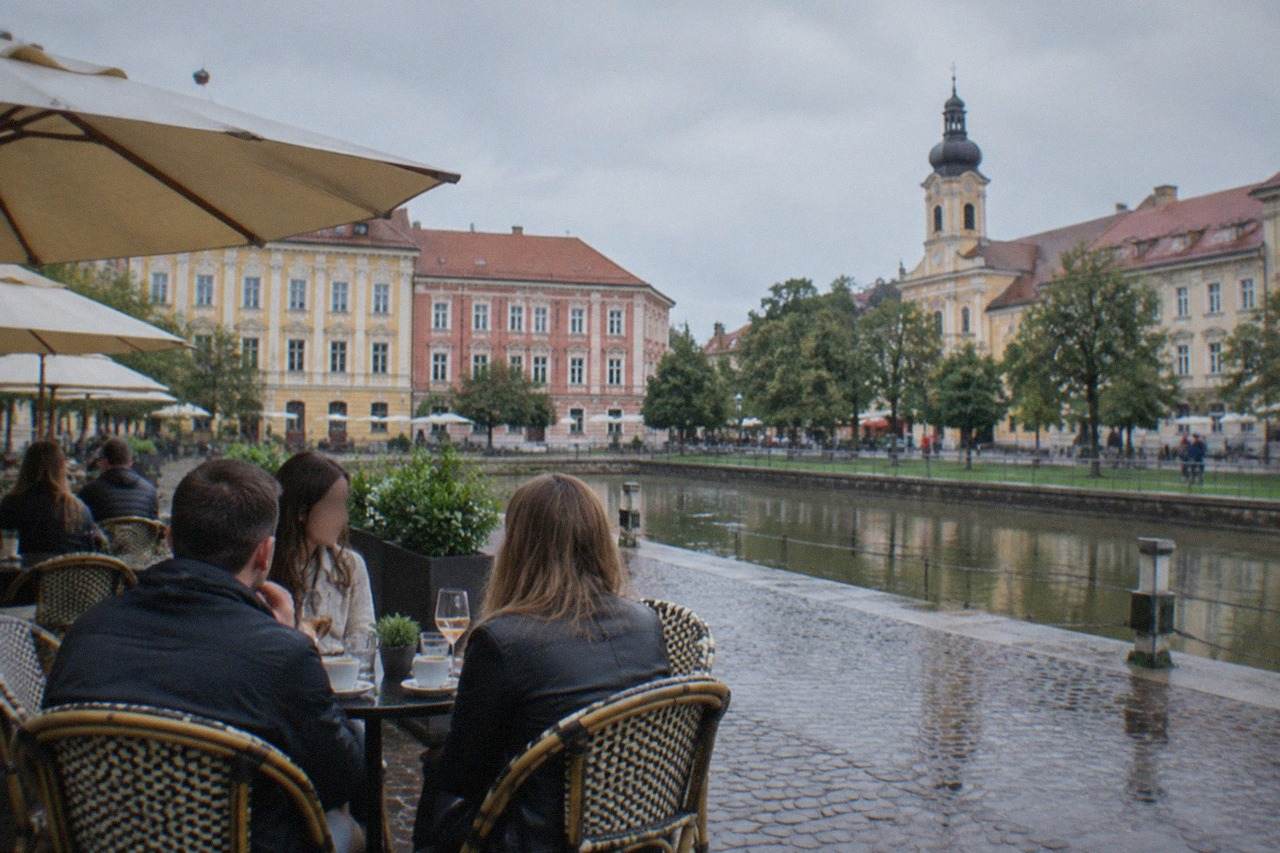
English is the everyday second language of Timisoara's visitor economy, spoken by the staff of hotels, central cafes, museums, and tour guides, and it is the language the city's own tourist infrastructure defaults to with foreigners. The Tourist Information Centre recorded 4,928 visitors in 2025, about 70 percent of them international, drawn mainly from Germany, Serbia, France, and Spain, so the desk answers in English all day. Romanians learn English in school, and in a university city the younger staff usually switch to it unprompted.
The city hall's economic reporting describes Timisoara as the place where Romania's first newspaper was printed in 1771 and where the Habsburg monarchy's first lamp-lit streets appeared in 1760, and that multilingual inheritance shapes how the city talks. Under its Hungarian name, Temesvár, and its German name, Temeswar, the city accumulated German-speaking merchants, Hungarian administrators, Serbian traders, and Jewish communities whose synagogues still stand in Cetate and Fabric. Modern Timisoara keeps that habit of reaching for whatever language the moment needs.
What the sources do not give is a percentage for English proficiency, and no such figure belongs on this page. What they do give is behavior: the Tourist Information Centre's 2025 numbers, and the fact that the city's guided tours, including a free GuruWalk essentials tour and a schedule of weekly English-language walking tours, run in English as their default offering. The operators are not doing that as a courtesy. They are doing it because their customers are overwhelmingly non-Romanian.
For a fuller picture of the city's language mix, see the companion page on what language is spoken in Timisoara, which covers Romanian itself in more depth.
Where English Works Best For Visitors In Timisoara?
English works best in Timisoara's tourism-facing layer: guided tours, hotels, central restaurants, museums with international exhibitions, and the information desks, and it thins out as you move into residential neighborhoods, local markets, and the shops where the customers are all Romanian. The city's 2025 visitor profile, with top origins including Germany, Serbia, France, and Spain, means central staff are practiced at serving people who share no language with them, and English is the bridge. A visitor staying in Cetate, Iosefin, or near Iulius Town will rarely hit a wall.
The guided tour scene is the clearest evidence. The listings for Timisoara walking tours specify English-language departures on fixed weekly days, a private walking tour with a local guide, and a street food tour conducted in English. The downtown dream tour and its peers exist because the operators expect an international crowd, and the reviews on those listings, written overwhelmingly in English by visitors from across Europe, confirm the expectation is met.
Museums follow the same pattern. The Memorial of the 1989 Revolution screens a documentary and posts its visitor information for international guests, and the National Museum of Art hosted the Pompeii exhibition that ran from late November 2025 into May 2026, a show built for an international audience. The city's newest venues, the MINA immersive art museum that opened in April 2026 and the MIC children's museum that opened the following month in Bastion Maria Theresia, were designed with foreign visitors in mind from the start.
The thin spots are predictable. In outlying districts, at non-central markets, and in the kinds of neighborhood restaurants where the menu is a chalkboard, Romanian and Hungarian carry the day, and pointing plus patience does the rest. The city's public transport system is essentially language-free: tickets are bought by contactless card, SMS, or kiosk, and the live arrivals site needs no conversation at all. If a trip extends beyond the city, the Banat countryside half-day trip with lunch is the kind of booking where the operator handles the language logistics for villages that see fewer foreign guests.
Do You Need Romanian In Restaurants And Shops In Timisoara?
You do not need Romanian to eat, sleep, and sightsee in central Timisoara, but a handful of phrases changes the tone of every interaction, and in smaller shops, taxi situations, and the residential quarters, Romanian is still the language that gets things done fastest. English menus are standard in the old town and around Piata Unirii and Piata Victoriei, and the central establishments are used to the city's international mix. Outside that core, expect a friendly improvisation.
The economics support the friendliness. Timisoara recorded 285,190 tourist arrivals in 2024 and 268,699 across January to November 2025, on top of the 283,256 who came in the 2023 Capital of Culture year, and the city's tourism strategy now targets continued growth in city-break visitors. Central businesses have simply adapted. The hotel sector added a Radisson Individuals property in the Baroque old town in June 2026, the kind of opening that assumes English-speaking guests as a baseline.
A practical note on money, since it is the other half of the restaurant interaction: the local currency is the Romanian leu, and the question of whether it is better to use cash or card in Romania has its own page. Prices in cafes and restaurants are quoted in lei, and a waiter's English will comfortably cover the bill even when it covers little else.
For travelers who want the language question handled entirely by someone else, a guided walk is the low-effort answer, and the listings carry full details.
What About Hungarian And German In Timisoara?
Hungarian and German are living heritage languages in Timisoara, not museum pieces, and visitors who speak either will find real use for them in the historic neighborhoods, at cultural institutions, and among older residents, though English remains the safest default with anyone under about forty. The city is the only European city to have kept three state theatres, in Romanian, Hungarian, and German, since 1953, which is the clearest official marker of how normal multilingualism is here.
That theatre fact comes from the city hall's own list of Timisoara's firsts, the same list that records the first horse-drawn tram in the Habsburg Empire in 1869 and the first electric street lighting on the European mainland in November 1884. The German-language theatre traces back to the Banat Swabian communities that settled under Habsburg rule, and the Hungarian theatre to the administration that ran the city as Temesvár. Both communities were hit hard by the history of that era, but the institutions survived, and so did the habit. The wider set of guides lives on Timisoara Travel Guide.
For a visitor, this heritage shows up in small ways. Building inscriptions in Cetate carry dates and names in German and Hungarian. The Serbian Orthodox Cathedral a few steps from Piata Unirii marks the city's third historic community, and the Serbian orthodox cathedral has its own page in this site's attractions section. The question of what Timisoara is known for is partly a question of languages, and the answer is not a single one of them.
None of this means you should plan a trip around German or Hungarian. The practical hierarchy for a short visit is English first, a few Romanian phrases second, and everything else as a bonus.
Which Romanian Phrases Help Most In Timisoara?
The Romanian phrases that help most in Timisoara are the greetings, the politeness words, and the bill, and a table of about ten covers almost every situation a visitor cannot solve in English. Romanian is a Romance language, so speakers of French, Italian, or Spanish will recognize much of the vocabulary, and the pronunciation is phonetic once you learn a few letter values. Locals respond warmly to any attempt, however rough.
| Romanian | Sounds like | English |
|---|---|---|
| Buna ziua | BOO-nah ZEE-wah | Good day |
| Multumesc | mool-too-MESK | Thank you |
| Va rog | vah ROHG | Please |
| Scuze | SKOO-zeh | Excuse me |
| Cat costa? | kaht KOSS-tah | How much does it cost? |
| Nota, va rog | NO-tah vah ROHG | The bill, please |
| Nu inteleg | noo een-tse-LENG | I do not understand |
| Vorbiti engleza? | vor-BEETZ eng-GLEH-zah | Do you speak English? |
| La revedere | lah reh-veh-DEH-reh | Goodbye |
| Da / Nu | dah / noo | Yes / No |
Two letters are the main traps for English speakers. The combination "ce" sounds like the "ch" in "cheese", and "ci" does too, so "cinci" (five) is pronounced roughly "cheench". The "ti" in words like "multumesc" behaves like the "ts" in "cats". That is genuinely all the phonetics a short visit needs.
The politeness dividend is real in Romania. A "buna ziua" on entering a small shop, rather than silence, changes the entire exchange that follows, and a "multumesc" on the way out closes it properly. In central Timisoara the staff will then happily continue in English. In the outer neighborhoods, those two words plus a smile may carry the whole transaction.
Should You Book English-Language Tours In Timisoara In Advance?
Booking Timisoara's English-language tours in advance is worthwhile for anything with a fixed schedule or a small group size, because the weekly English departures run on specific days and the day trips into the Banat and Transylvania have limited seats, while the city's short walking tours can often be arranged closer to the date. The listings state their own schedules, and the operator's live listing is the place to confirm current availability. Advance booking matters most for food tours and private day trips.
The reasoning comes from the supply side. A city receiving close to 300,000 tourist arrivals a year, with an average stay under two days according to the 2025 city report, has a visitor flow that concentrates heavily on weekends and event dates. Timisoara's calendar includes the Jazz Festival in late September, the Flight Festival in June, and Ziua Timisoarei at the end of July, and around those dates the informal English-language offerings fill first. The overview of things to do in Timisoara is the place to see how tours sit alongside the city's independent sights.
Between the tours and the phrases, the language question answers itself. Timisoara is a city that has been switching languages for its visitors since it printed Romania's first newspaper in German in 1771, and English is simply the current chapter of a very old habit.
Common Questions About English In Timisoara
Do they speak English in Timisoara?
Yes, English is widely spoken in Timisoara's hotels, central restaurants, museums, and tour operations, and the Tourist Information Centre reported that about 70 percent of its 2025 visitors were international, so English is its working language. Coverage thins in residential neighborhoods and small local shops.
Is English enough for a short visit to Timisoara?
For a city-break visit centered on Cetate, Piata Unirii, Piata Victoriei, and the main museums, English is enough for eating, sleeping, transport tickets, and sightseeing. Public transport needs almost no conversation, since tickets work by contactless card and the live arrivals site is visual.
Do people in Timisoara speak Hungarian or German?
Yes, both are heritage languages with living institutions: the city has had state theatres in Romanian, Hungarian, and German since 1953, which the city hall lists among its historic firsts. Older residents in particular may use one of them, though English is the safer default with younger people.
What language is spoken in Timisoara?
Romanian is the official and everyday language of Timisoara, as it is across Romania. The city's distinctive feature is its multilingual layer of Hungarian, German, and Serbian heritage alongside the national language, with English added by the tourism sector.
Should I learn Romanian phrases before visiting Timisoara?
A small set helps: good day, thank you, please, and the bill. Romanian is a Romance language, so French, Italian, and Spanish speakers will recognize much of it, and locals respond warmly to any attempt, even in a city where English usually takes over.
Do Timisoara tours run in English?
Yes. The city's walking tours, including a weekly English-language schedule and a free GuruWalk tip-based essentials tour, list English as their operating language, and the food and day-trip operators into the Banat and Transylvania also run in English. The operator's live listing confirms each departure.